Why FinOps Should Be a Priority at Your Company

Cloud computing has fundamentally changed how companies build, scale, and operate software. Infrastructure can be provisioned in minutes, teams can experiment freely, and businesses can grow globally without large upfront investments. However, this flexibility comes with a new challenge that many organizations underestimate: cloud costs and the complexity of managing the costs for dozens of cloud and SaaS providers such as AWS, GCP, Azure, OpenAI, Snowflake, DataDog, and others.
What starts as a convenient pay-as-you-go model often turns into unpredictable monthly bills, limited cost visibility, and growing friction between engineering, finance, and leadership. As cloud usage increases, so does financial complexity. This is where FinOps becomes essential.
FinOps is no longer just a best practice for large enterprises. It is a critical discipline for any organization that wants to scale efficiently, make informed decisions, and get real business value from the cloud. In this article, we will explore what FinOps is, why it matters, and how platforms like Cloudchipr can help organizations implement it successfully.
What Is FinOps and Why Does It Matter?
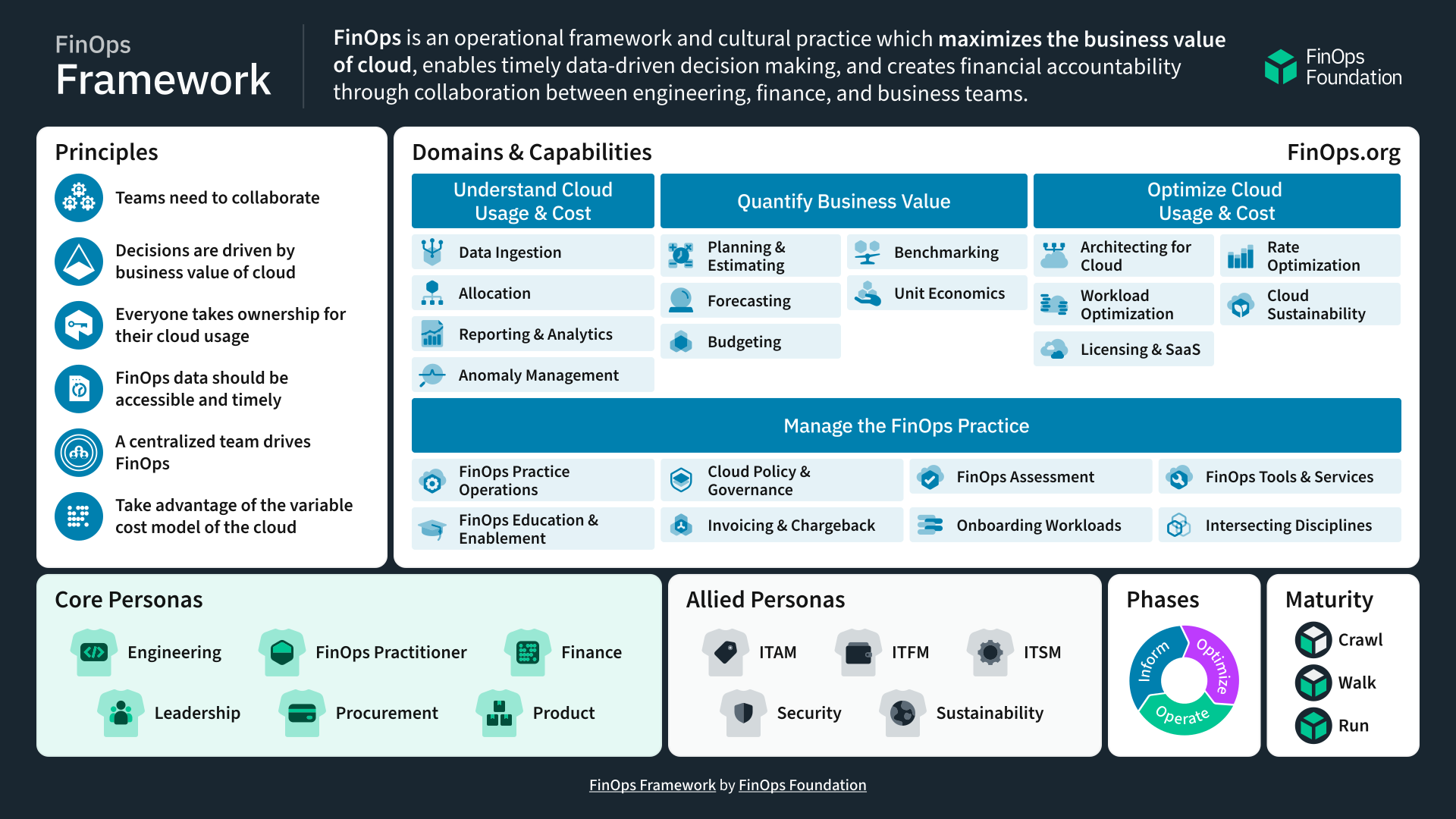
FinOps, short for Financial Operations, is a cultural and operational practice that helps organizations manage cloud spending collaboratively and efficiently. It brings together engineering, finance, and business teams to make data-driven decisions about cloud usage and cost.
At its core, FinOps is built on a few key principles:
- Cloud spend should be visible and understandable to everyone involved
- Teams should take ownership of the costs they generate
- Decisions should balance cost, performance, and business value
- Optimization is a continuous process, not a one-time effort
It is important to clarify what FinOps is not. FinOps is not simply about reducing cloud bills at all costs. It is not a finance-only responsibility, and it is not just another reporting tool. Instead, it is a shared approach that enables teams to spend wisely while still moving fast.
As cloud environments grow more complex, FinOps provides the structure needed to manage that complexity without slowing innovation.
Why Cloud Costs Become a Problem Without FinOps
Companies often adopt cloud services prioritizing agility and expansion over sustainable financial management. While initial cloud expenses might seem contained, issues typically emerge as the number of cloud providers and the total spend grow.
Common reasons cloud costs spiral out of control include:
- Overprovisioned resources that are never right-sized
- Idle or forgotten workloads that continue to run
- Lack of clear ownership for shared infrastructure
- Limited visibility into which teams or products are driving costs
- Manual, delayed, or fragmented cost reporting
- Absence of a single source of truth for multi-cloud analytics and visibility
Engineering teams typically optimize for reliability, performance, and delivery speed. Finance teams, on the other hand, are responsible for budgeting, forecasting, and cost control.
Without a FinOps framework, these teams operate in silos, often looking at the same data through completely different lenses.
The result is a reactive approach to cloud spending. Costs are reviewed after the fact, surprises appear at the end of the month, and optimization becomes an urgent but stressful exercise. FinOps shifts this model from reactive to proactive.
The Business Value of FinOps
FinOps is not just a cost management strategy. When implemented correctly, it delivers measurable business value across the organization. Let’s go through the values.
Cost Transparency and Accountability
One of the most immediate benefits of FinOps is improved visibility. Teams gain a clear understanding of where cloud money is going and why. Costs can be allocated by such dimensions as team, service, environment, or product, driving accountability and predictability across the organization.
With a shared view of cloud spending, discussions move away from blame and toward ownership. Engineers can see the financial impact of their architectural choices, and finance teams gain confidence in the numbers they report.
Cloudchipr supports this transparency by providing unified cost visibility across more than 30 cloud providers. Organizations can analyze spending at a granular level without stitching together separate tools or spreadsheets.
Better, Data-Driven Decisions
FinOps enables organizations to make informed trade-offs. Instead of asking whether something is expensive, teams can ask whether it is worth the cost.
For example:
- Is higher availability justified for this workload?
- Should this product be optimized or redesigned?
- Does this feature generate enough value to justify its infrastructure cost?
- How much do we spend on R&D, and what is the ROI?
By combining cost data with usage trends, teams can make these decisions based on evidence rather than assumptions. Cloudchipr helps by offering real-time insights and historical analysis, allowing teams to evaluate the impact of changes quickly.
Predictable Forecasting and Budgeting
Accurate forecasting is one of the toughest challenges in cloud environments. Usage fluctuates, teams deploy frequently, and new services are continuously introduced.
FinOps improves forecasting by anchoring it in real usage patterns. Finance teams gain access to reliable historical data, while engineering teams understand how their roadmaps impact future spend.
Cloudchipr strengthens this process with AI-driven forecasting, anomaly detection, and proactive alerting. Unexpected spikes in spending are identified early, before they turn into financial problems.
Improved Cross-Team Collaboration
Perhaps the most underrated benefit of FinOps is improved collaboration across teams. FinOps establishes a shared language between technical and financial stakeholders, enabling more effective communication and better decision-making.
Engineers no longer see cost discussions as constraints imposed by finance. Finance teams no longer feel disconnected from technical decisions. Everyone works toward the same goal: maximizing business value from cloud investments.
FinOps as a Growth Enabler, Not a Constraint
A common misconception is that FinOps slows teams down. In reality, the opposite is often true.
Organizations that lack financial discipline tend to hesitate when scaling. Uncertainty around costs creates fear, and fear limits experimentation. Teams become cautious not because they want to be, but because they do not understand the financial impact of growth.
FinOps removes this uncertainty. When teams know how much something costs and why, they can scale with confidence. Optimized spending frees up the budget for innovation, new features, and expansion into new markets.
In fast-growing companies, FinOps acts as a safety net. It allows growth without chaos, ensuring that scaling does not come at the expense of financial stability.
Common Misconceptions That Delay FinOps Adoption
Despite its benefits, many organizations delay FinOps adoption due to common misunderstandings.
One misconception is that FinOps is only for large enterprises. In reality, smaller teams often benefit the most because early habits shape long-term cost efficiency.
Another belief is that FinOps can wait until cloud costs become a serious problem. By then, technical and financial debt are harder to untangle. FinOps is far easier to adopt gradually than under pressure.
Some organizations also assume FinOps is purely about cost reduction. While savings are important, the true goal is value optimization.
Finally, there is the assumption that tools alone can solve the problem. Tools are critical, but FinOps also requires process changes, shared responsibility, and leadership support.
How Cloudchipr Helps Enable FinOps in Practice

FinOps relies heavily on accurate, accessible data. Without the right tooling, even the most motivated teams struggle to maintain visibility and momentum.
Cloudchipr is designed to support FinOps practices by making cloud cost data actionable and easy to understand. It brings together information from multiple cloud providers into a single platform, reducing complexity and manual effort.
Key ways Cloudchipr supports FinOps include:
- Centralized multi-cloud cost visibility across AWS, Azure, Google Cloud, Kubernetes, and 30 other providers
- Near real-time monitoring to detect unusual spending early
- Flexible cost allocation and robust tagging support
- Anomaly detection to highlight unexpected cost changes
- Optimization insights to identify inefficiencies
- Actionable workflows that turn insights into outcomes
- Full container cost visibility and allocation
- Rate optimization and commitment planning
- Dedicated FinOps professional
- An AI-powered Copilot and Infrastructure Architect to support informed technical decisions
Cloudchipr is built to serve multiple stakeholders. Engineers get practical insights and are able to automate actions. Finance teams get clarity and consistency. Leadership gets a high-level view that supports strategic decision-making.
It is important to note that Cloudchipr delivers not only the platform, but also experienced FinOps and DevOps professionals who fully close the loop between insight and execution.
How to Get Started with FinOps at Your Company
Implementing FinOps does not require a massive reorganization. It can start with small, deliberate steps.
- Acknowledge that cloud cost management is a shared responsibility. Leadership buy-in is essential to reinforce this mindset.
- Bring the right people together. FinOps works best when engineering, finance, and product teams collaborate regularly.
- Focus on visibility before optimization. Understanding where money is spent is more important than immediately trying to reduce costs.
- Define clear metrics that matter to your business. Examples include cost per customer, cost per transaction, or infrastructure cost per feature.
- Adopt tooling that supports your goals. Platforms like Cloudchipr accelerate FinOps adoption by reducing manual work and improving accuracy.
- Finally, treat FinOps as an ongoing practice. Cloud environments change constantly, and FinOps maturity grows over time.
Conclusion: FinOps as a Competitive Advantage
Cloud adoption is no longer a differentiator. How well you manage cloud costs is.
FinOps provides the framework organizations need to operate confidently in a cloud-first world. It turns cloud spending from an opaque expense into a strategic asset.
Companies that prioritize FinOps spend smarter, scale faster, and make better decisions. They avoid surprises, reduce waste, and align technology with business outcomes.
With the right mindset, processes, and platforms like Cloudchipr, FinOps becomes not just a cost control mechanism but a true competitive advantage.
In a world where cloud usage continues to grow in scale and complexity, FinOps is no longer optional. It is a necessity for building sustainable, financially intelligent organizations.