10 Best Alternatives to CloudHealth in 2026
.png)
Introduction
Cloud cost management has evolved far beyond basic visibility and reporting. While traditional cloud management platforms laid important groundwork, modern organizations need comprehensive platforms that provide deep cost optimization, multi-cloud support, team collaboration, automation, and real-time actionable insights across their entire cloud infrastructure.
CloudHealth is a well-established cloud management platform that has been widely used for multi-cloud visibility and governance, but it may not be the right fit for every organization. Many companies look for alternatives that offer more advanced optimization capabilities, better user experience, deeper Kubernetes support, or tools that extend beyond visibility into execution and automation.
This guide explains what CloudHealth offers and compares leading alternatives. It will help you understand the differences and choose the cloud cost optimization platform that fits your organization best.
This analysis is based on publicly available information, including customer reviews and insights from platforms such as G2, Gartner, documentation, and similar industry sources.
What is CloudHealth?
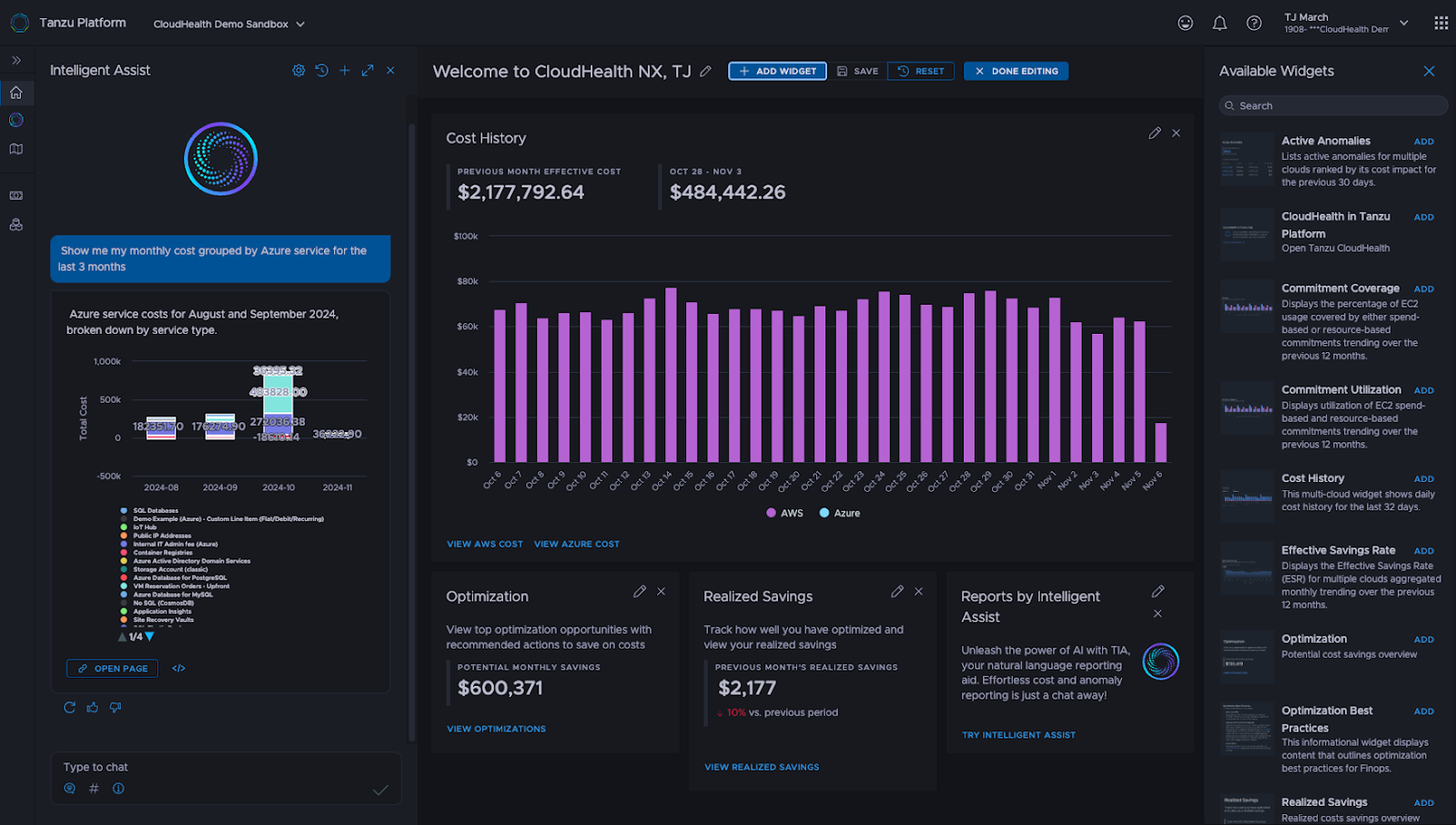
CloudHealth by VMware is a cloud management platform designed to help organizations manage and optimize their multi-cloud environments across AWS, Azure, and Google Cloud. The platform provides visibility into cloud spending, resource utilization, and governance across cloud infrastructure.
CloudHealth focuses on cost reporting, policy-driven governance, and compliance monitoring. It offers features for cost allocation, chargeback and showback, rightsizing recommendations, and Reserved Instance management. The platform is commonly used by enterprise IT teams, managed service providers, and organizations with complex multi-cloud environments that require standardized reporting and governance controls.
CloudHealth's Limitations
While CloudHealth provides multi-cloud visibility and governance capabilities, users commonly report several limitations based on customer reviews from G2, Gartner, and similar platforms.
Fragmented cost optimization recommendations
CloudHealth lacks a centralized view for cost savings recommendations across all services. While commitment recommendations and a few other specific optimizations are available, there is no single location to view all potential savings opportunities, such as unassigned Elastic IPs or underutilized resources. This fragmentation makes it harder for teams to understand the full picture of potential cost savings and prioritize optimization efforts.
Performance and connectivity issues
Users frequently report network and performance problems, including screen lag, slow loading times, and occasional freezing that can last for several minutes. These connectivity and speed issues are commonly mentioned across VMware products and can disrupt workflows, especially when teams need quick access to cost data for time-sensitive decisions.
Limited integrations and PaaS coverage
The platform has limited integration with other Azure services such as Web Apps, Service Bus, or Traffic Manager. Users also note that PaaS (Platform as a Service) coverage is weak compared to IaaS resources, leaving gaps in visibility for teams using managed services and modern cloud architectures.
Complex and inflexible reporting
Reporting features are often described as complex to manage and run. Users find it difficult to create custom reports that match their specific needs, and the lack of export options to common formats like Microsoft Office files makes it harder to share insights in presentations and stakeholder meetings. Additionally, the notifications system and settings are difficult to configure and manage.
Limited UI customization
The platform does not allow users to personalize the navigation or customize frequently accessed views. The inability to tailor the interface to individual workflows slows down daily operations, particularly for users who need to access the same reports or dashboards regularly.
Unclear governance enforcement
While CloudHealth offers governance features, users report that there is no clear way to enforce governance frameworks consistently across the organization. This makes it challenging for teams to ensure policy compliance and maintain control over cloud spending.
Pricing concerns
Users frequently cite cost as a concern. CloudHealth can be expensive, particularly for smaller organizations or teams with limited budgets, making it less accessible compared to more modern, competitively priced FinOps platforms.
1. Cloudchipr
Cloudchipr is an enterprise-grade cloud cost management and optimization platform designed to help organizations allocate, manage, and reduce cloud spending.
Cloudchipr goes beyond reporting by connecting costs to business metrics, live resources, and automated actions. Users can track unit costs, manage commitments, identify waste, and automate workflows, all from one platform.
Below are the key features that make Cloudchipr a practical choice for continuous cloud cost control.
Dimensions
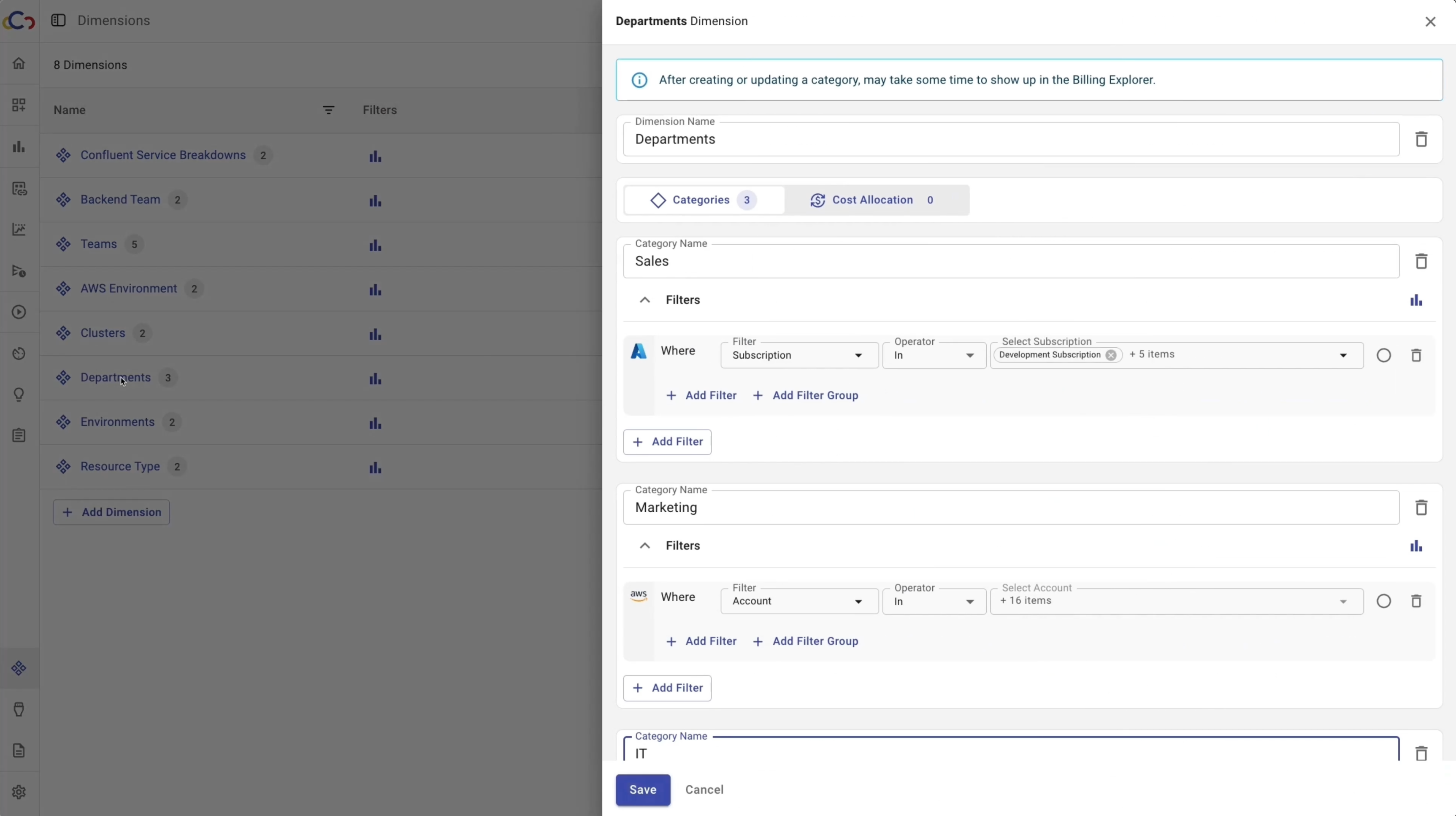
Dimensions allow teams to organize and analyze cloud costs in a way that matches how their business is structured. Each Dimension is made up of categories, which are groups of rules that act like virtual tags, grouping resources without requiring perfect tagging.
Categories use attributes to automatically place costs in the right group as environments change. This keeps cost views accurate and consistent without manual updates.
The Shared Cost feature then distributes shared expenses across teams or projects based on manual, even split, or telemetry allocation, ensuring complete and reliable cost attribution.
Telemetry Upload & Unit Cost Economics
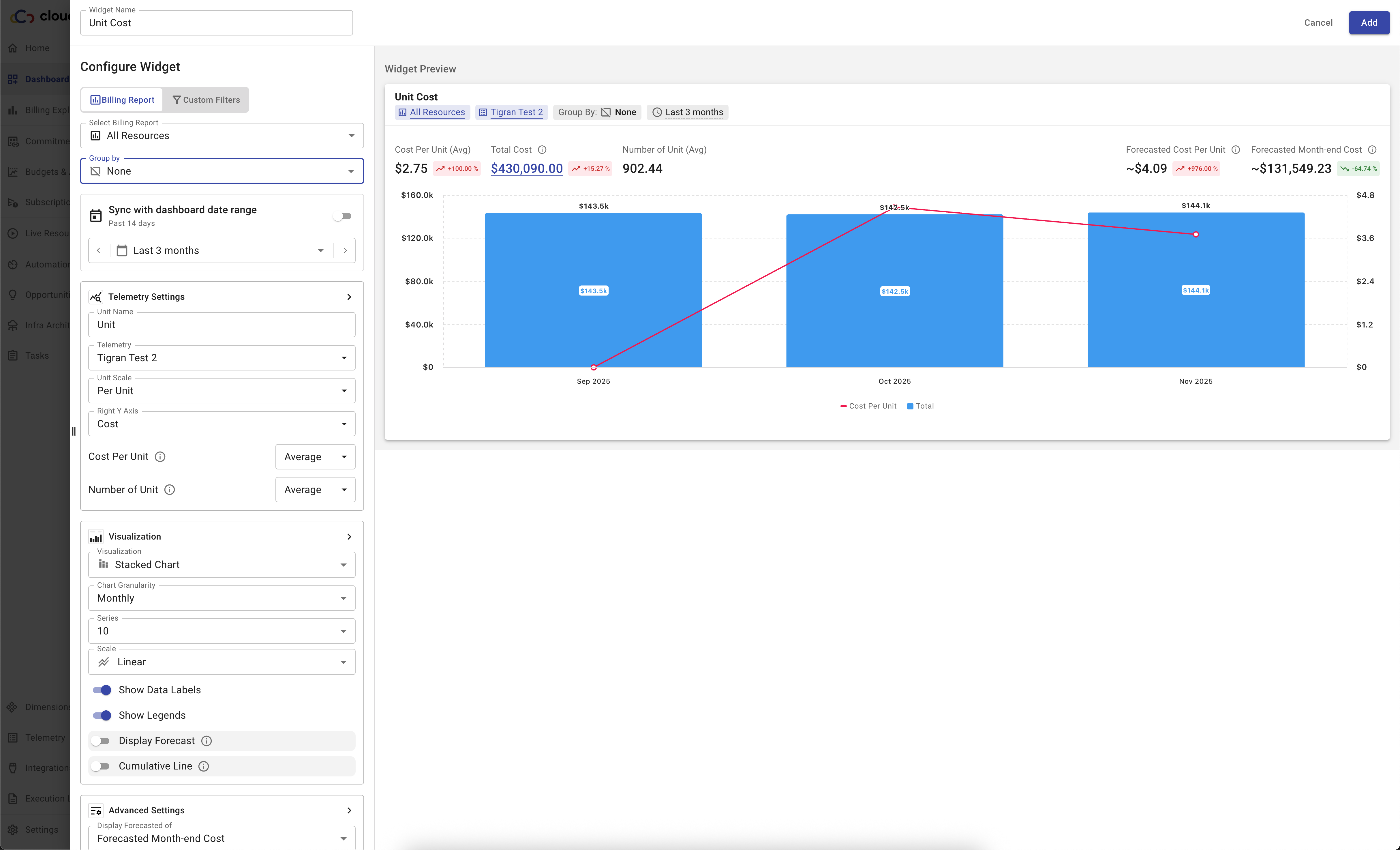
Teams can upload their data, like users, customers, API calls, revenue, etc.
Uploaded data can be used for weighted-based cost allocation in Dimensions, allowing shared costs to be distributed based on usage instead of just percentages.
Teams can use uploaded data to calculate unit cost economics on the widget, which shows trends and forecasts over time, helping teams understand how cloud spend scales with growth.
Commitments

Cloudchipr provides a single, clear view of all cloud commitments, including Reserved Instances and Savings Plans, in one place. Teams can easily track coverage, utilization, real cost, net savings, and effective savings rate across selected time ranges.
Cloudchipr shows which resource types and accounts are covered, provides visibility into actual usage, and highlights where commitments are underutilized or missing.
Cloudchipr also provides AI recommendations to improve coverage and reduce on-demand spend.
Billing Explorer
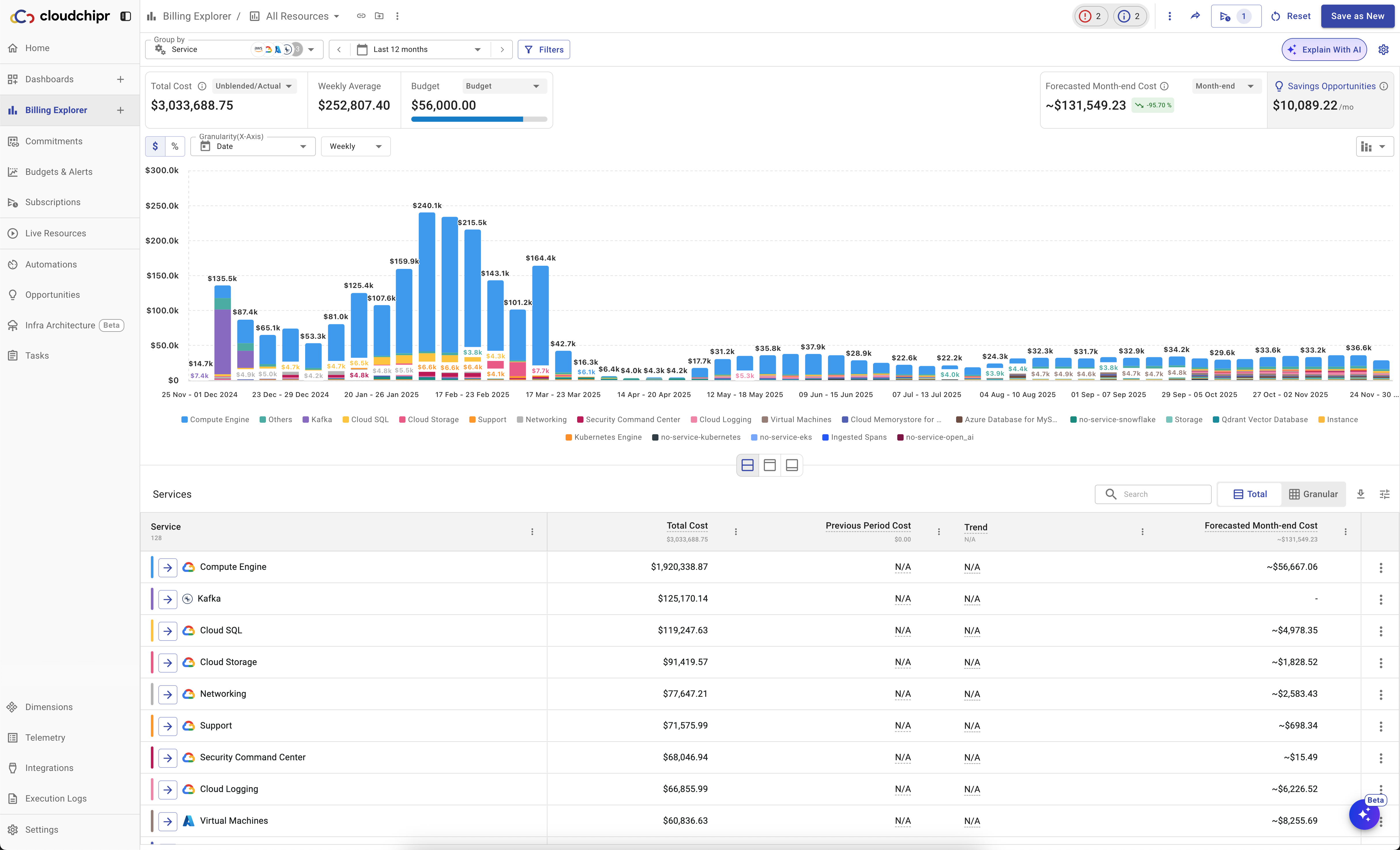
Cloudchipr's Billing Explorer gives users a fast, flexible way to understand and manage multi-cloud costs in one place. It provides a complete view of cloud spend, including Kubernetes container costs, and allows users to group and filter data by account, service, region, tag, workload, or any preferred dimension.
From high-level reports, users can drill down to individual resources to see usage metrics, tags, and related savings opportunities, making it easy to understand what is driving costs and where action is needed.
Users can see forecasted costs, set budgets directly from reports, and get notified before limits are exceeded. AI-powered anomaly detection and plain-language explanations help quickly understand cost spikes without manual investigation.
Dashboards
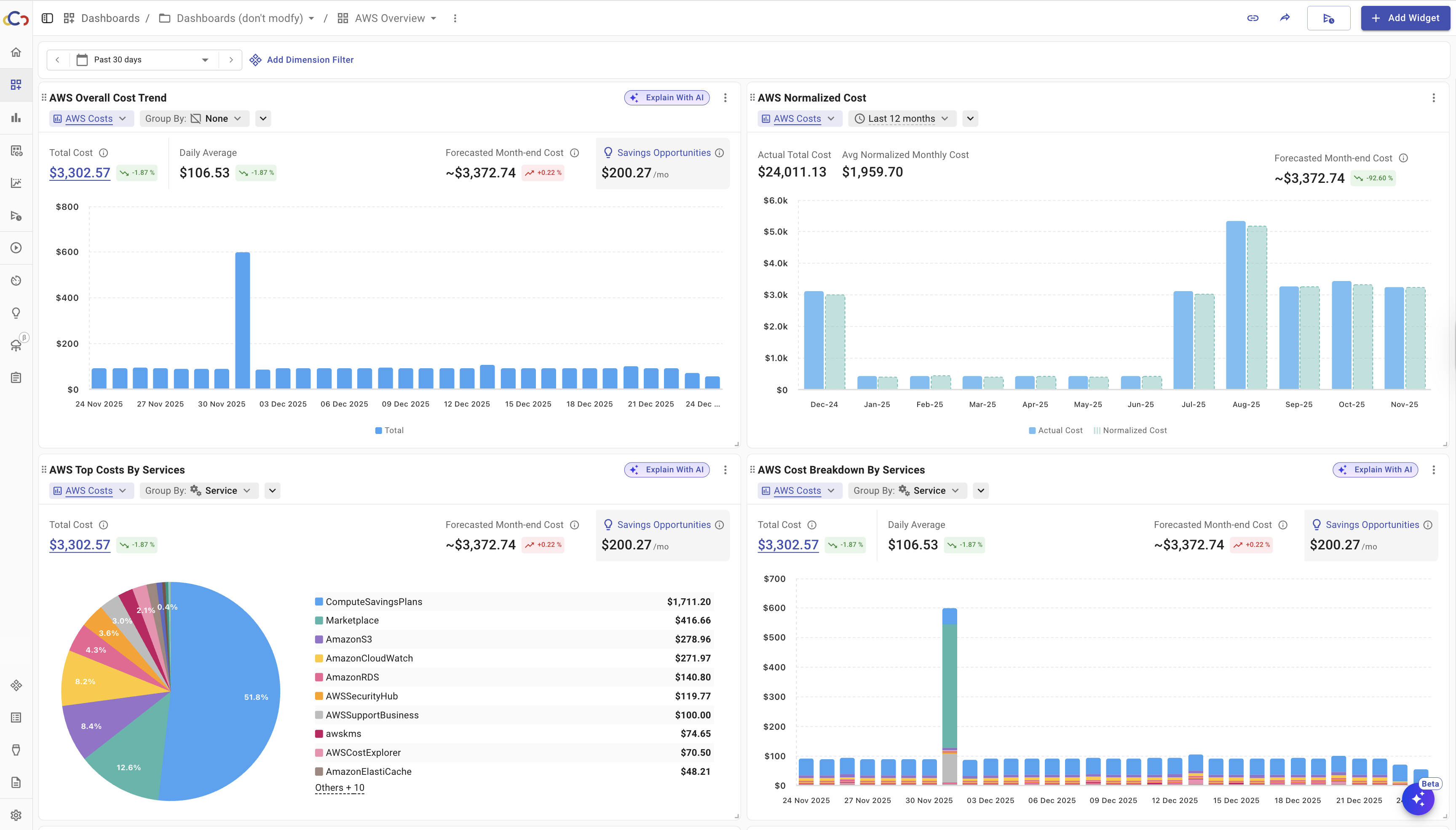
Users can create dashboards directly from billing reports or custom filters, making it easy to track key metrics over time and tailor views for different teams or stakeholders. Dashboards are fully customizable with a wide range of widgets, including Billing Explorer, Cost Anomalies, Commitment Utilization, Coverage, Normalized Cost, Savings Opportunities, Carbon Emissions, Unit Cost, and more, giving finance, engineering, and leadership clear visibility into the metrics that matter most.
Users can share dashboards across teams or subscribe to them, receiving scheduled updates automatically via email or Slack.
Budgets and Alerts
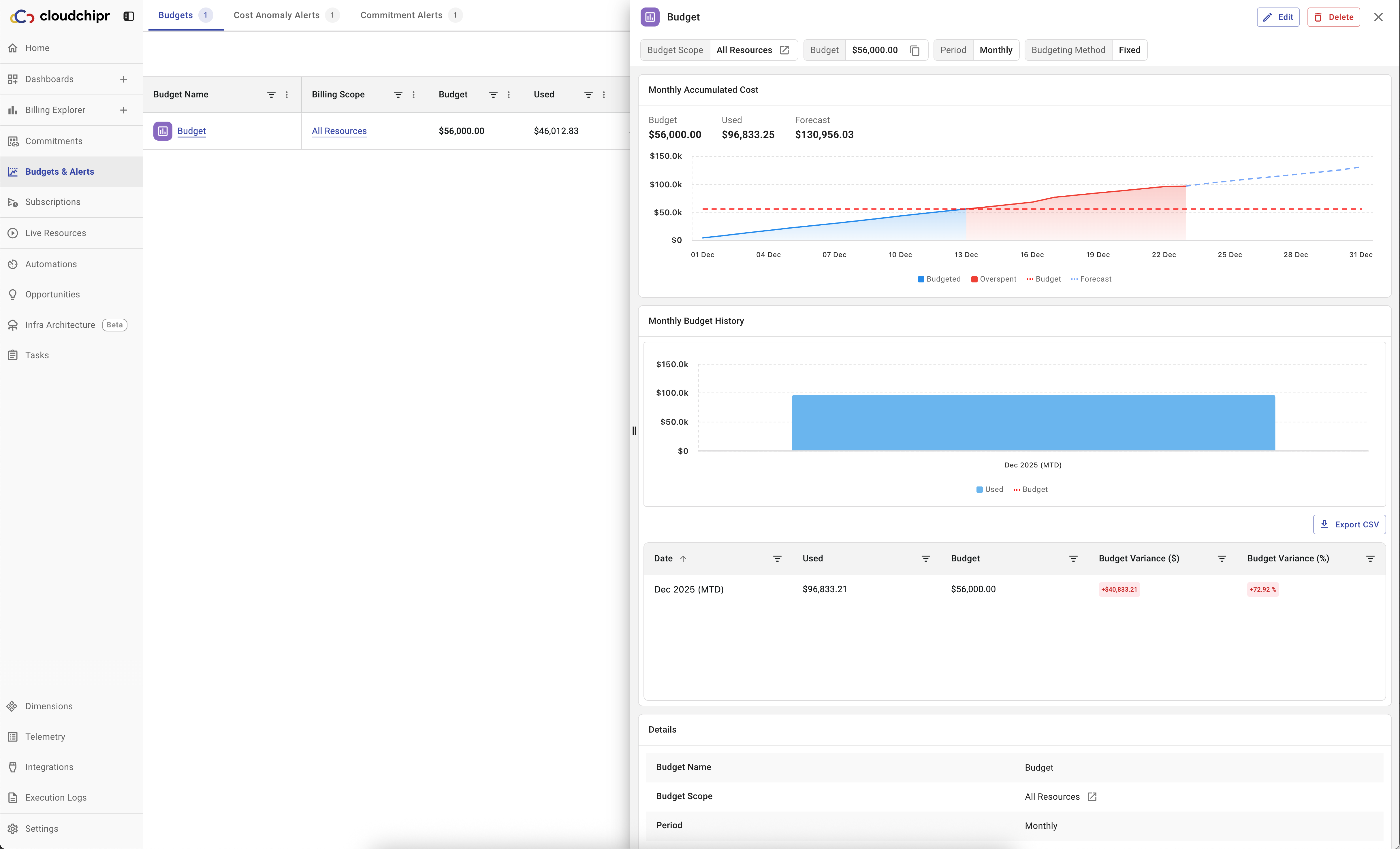
Cloudchipr provides powerful and flexible budgets and alerts that help teams stay in control of cloud spending before issues become problems.
Budgets can be created from billing reports or custom filters, aligning them with how cloud spend is organized across the environment. Users can track both actual and forecasted spend and receive alerts before limits are exceeded.
Anomaly alerts detect unusual changes by comparing current costs with previous periods. This helps teams quickly spot unexpected spikes and investigate issues before they grow into larger problems.
Commitment alerts monitor Reserved Instances and Savings Plans, sending early warnings to avoid underutilization, missed renewals, and unnecessary on-demand spend.
Live Resources
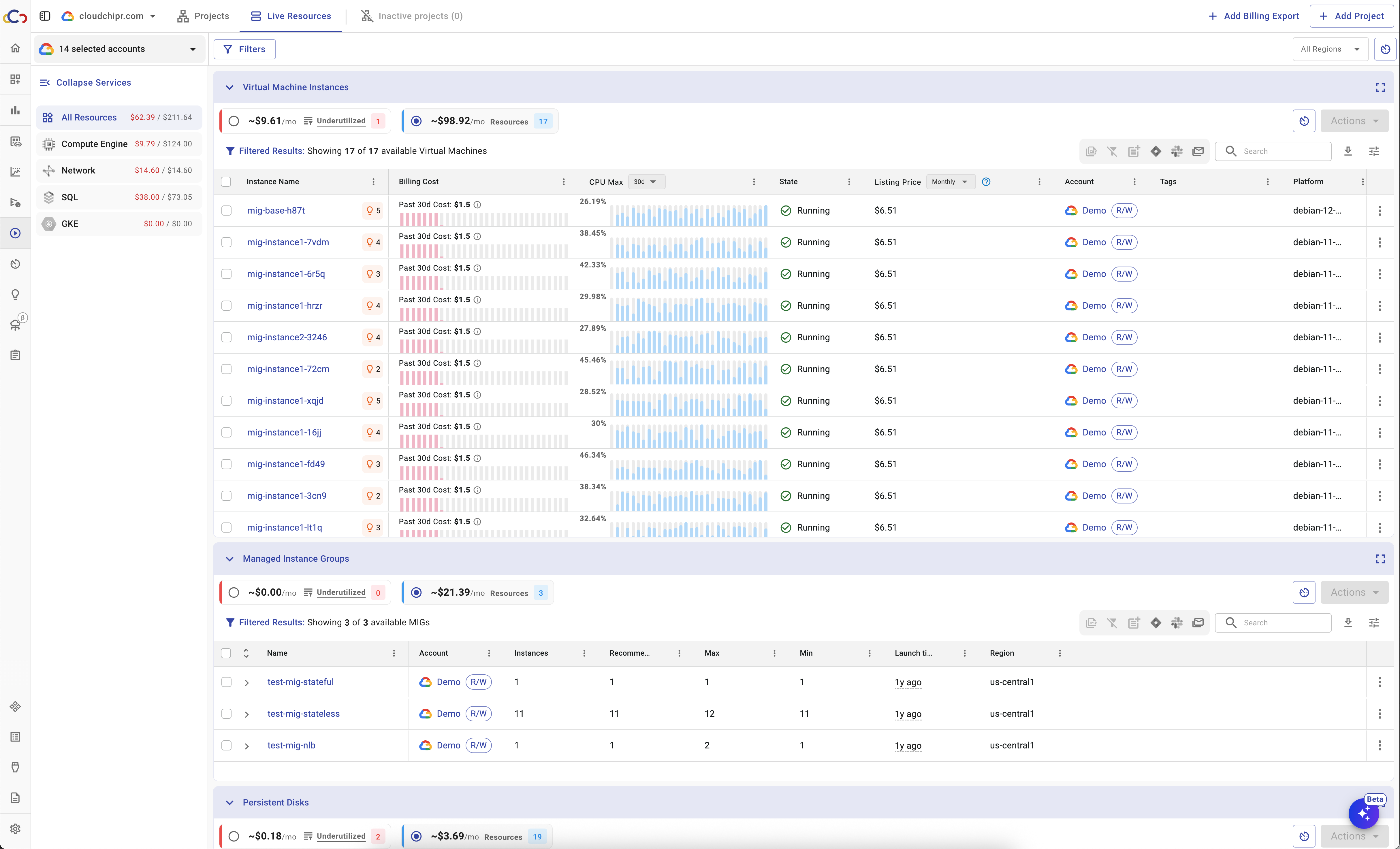
Cloudchipr's Live Resources gives a real-time, unified view of all cloud resources across AWS, Azure, GCP, and Kubernetes. Users can see usage metrics in one place, without switching between cloud consoles. Each resource is fully actionable; users can stop, start, reboot, snapshot, delete, or protect resources, and see related costs, usage history, commitment coverage, and savings opportunities.
Live Resources also includes utilization policies that automatically identify idle or underutilized resources. Users can take action immediately, collaborate via Slack or tasks, or automate cleanups with workflows.
Kubernetes Cost Optimization
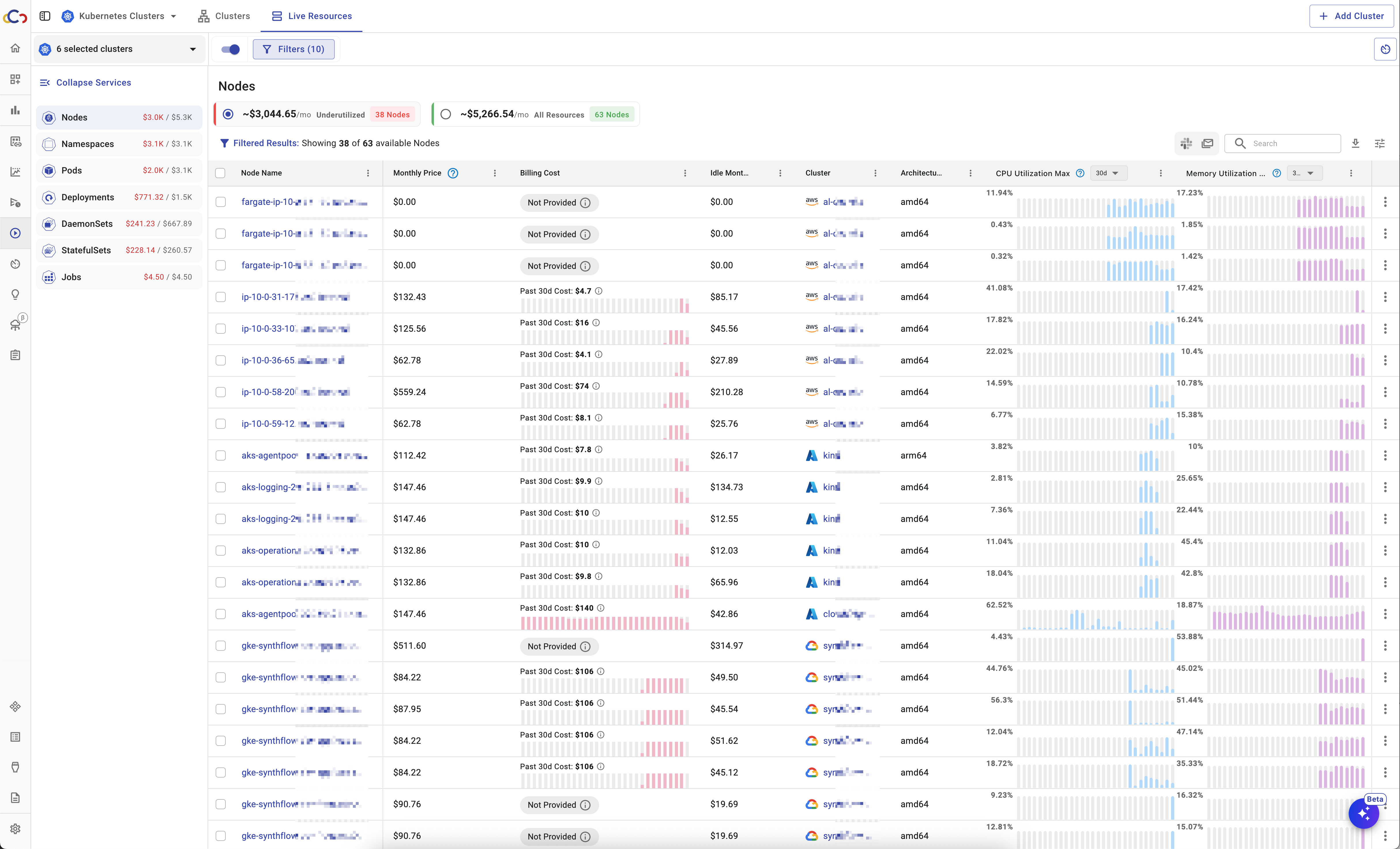
Cloudchipr provides deep visibility and optimization for Kubernetes across all major cloud providers. Users can monitor clusters, namespaces, nodes, pods, and workloads in real time, with clear views of CPU, GPU, and memory usage compared to what is actually consumed.
Cloudchipr highlights underutilized Kubernetes resources and delivers AI-powered optimization recommendations to reduce waste early.
Automation
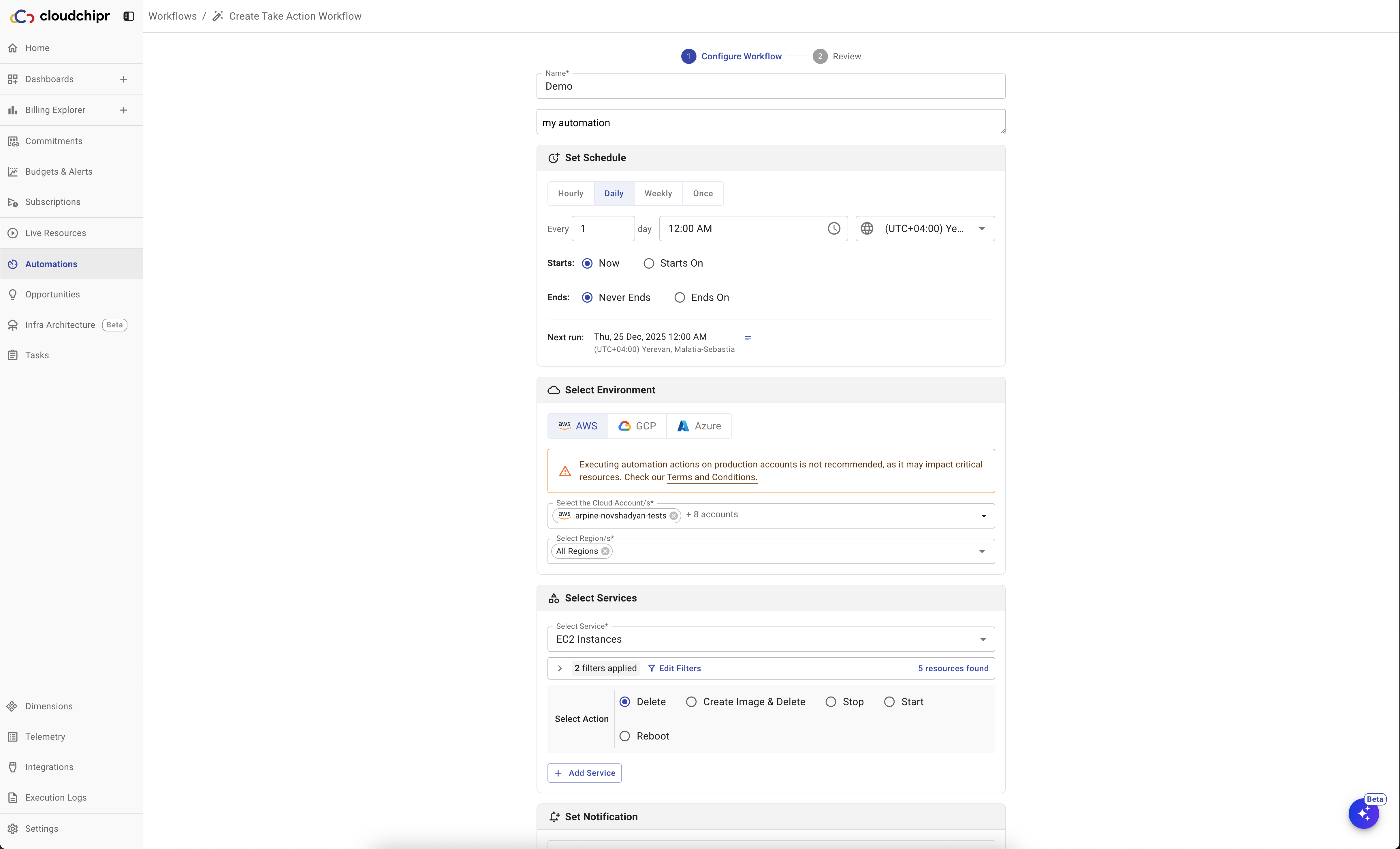
Cloudchipr helps companies automate cost-saving actions without writing code. It offers two types of automation: Workflows and Off-Hours. Workflows monitor resources and automatically take actions based on custom conditions.
Off-Hours automations schedule resources to stop and start at defined times to avoid paying for unused capacity outside business hours.
Cloudchipr AI Agents
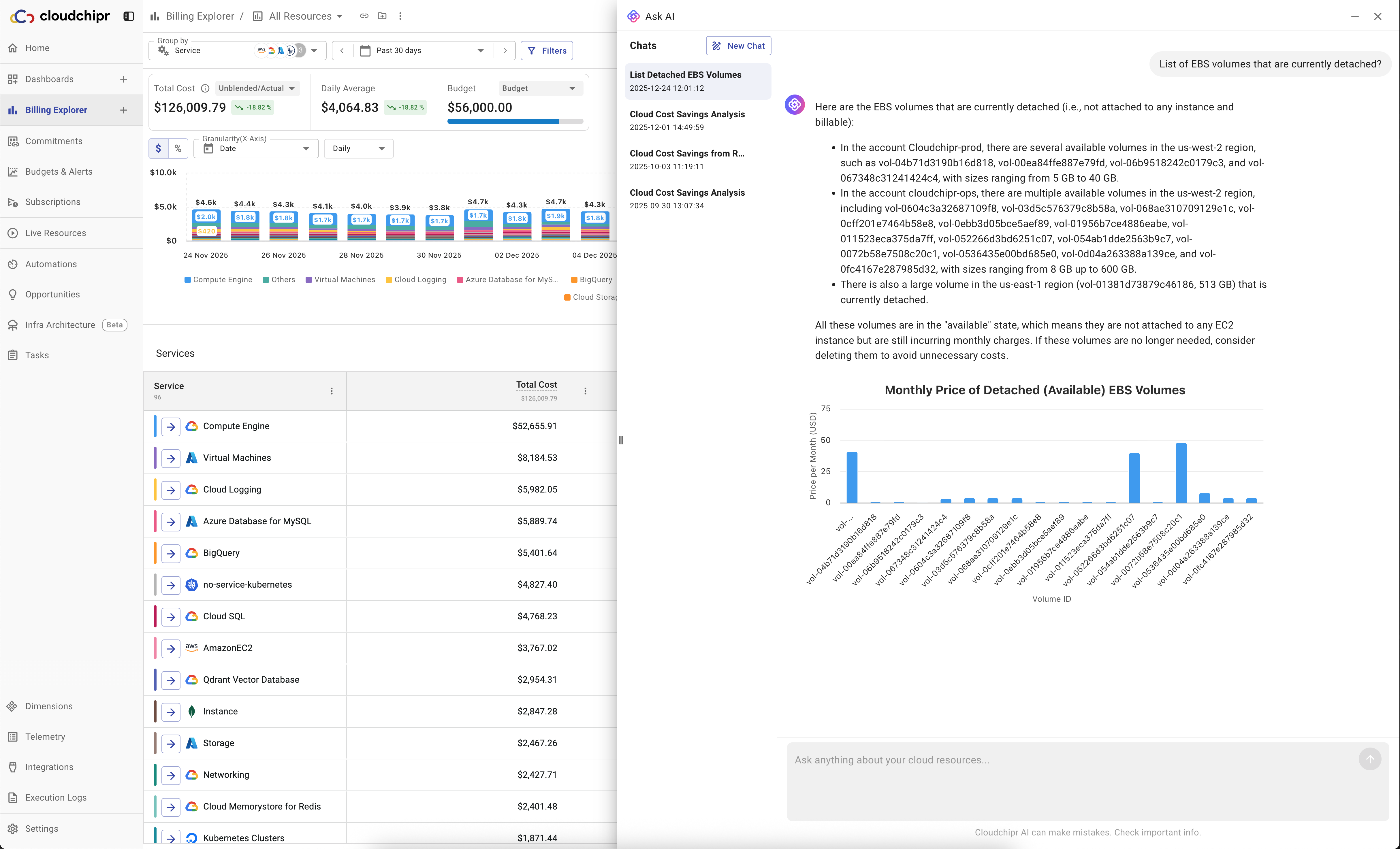
Cloudchipr AI Agents act as on-demand FinOps and DevOps experts inside the platform. Users can ask questions in plain language to understand costs, explain reports, analyze trends, and generate charts or reports.
Explain with AI highlights cost trends, top drivers, unusual spikes in any report and suggested next steps.
Built-in collaboration and task management
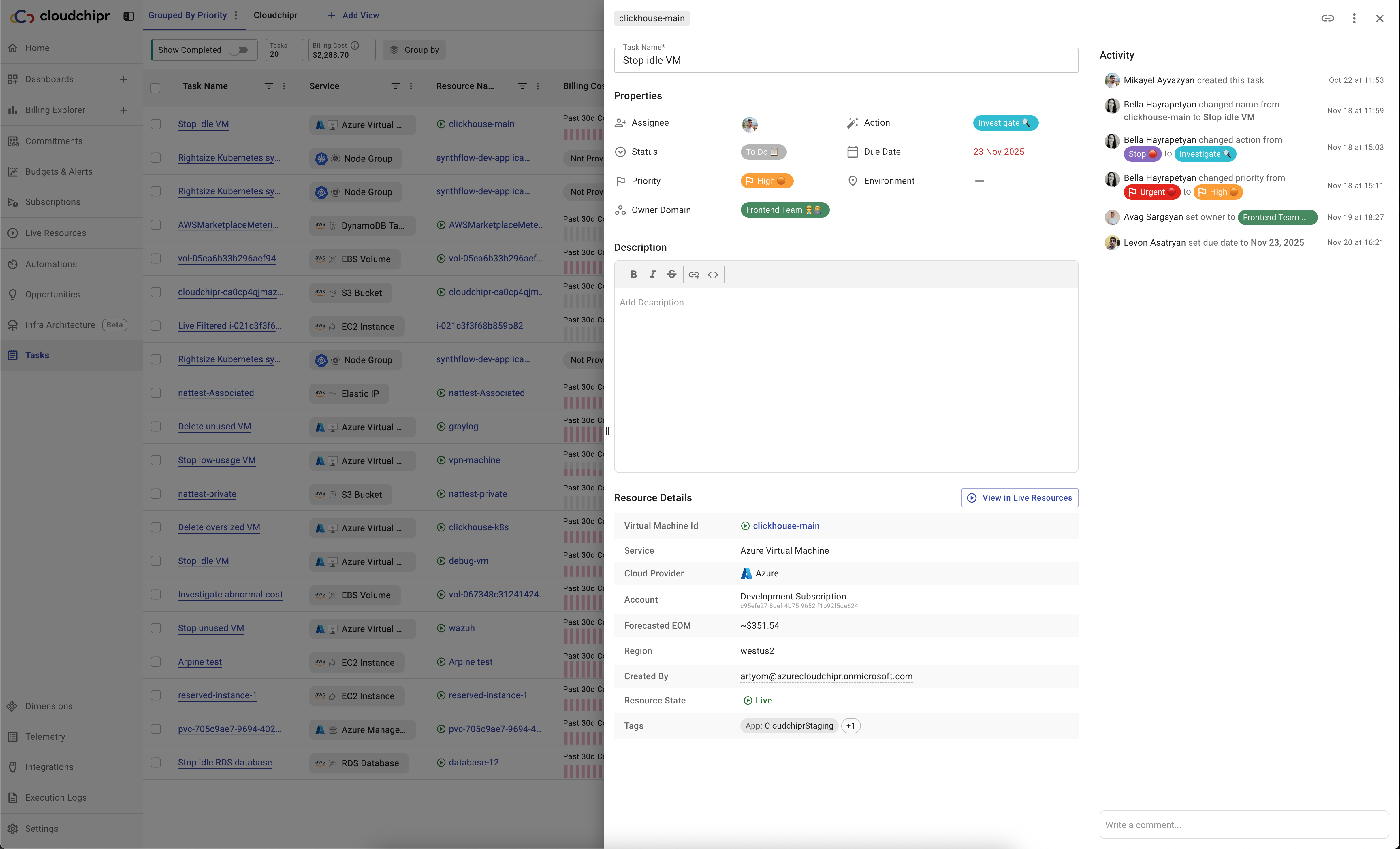
Cloudchipr treats cloud cost optimization as teamwork, not just a FinOps task.
When an issue is found, users can create tasks directly from live resources or savings opportunities, assign owners, give priorities and due dates, and track until completion. This makes it easy for teams to collaborate with clear accountability and shared visibility.
2. Apptio Cloudability
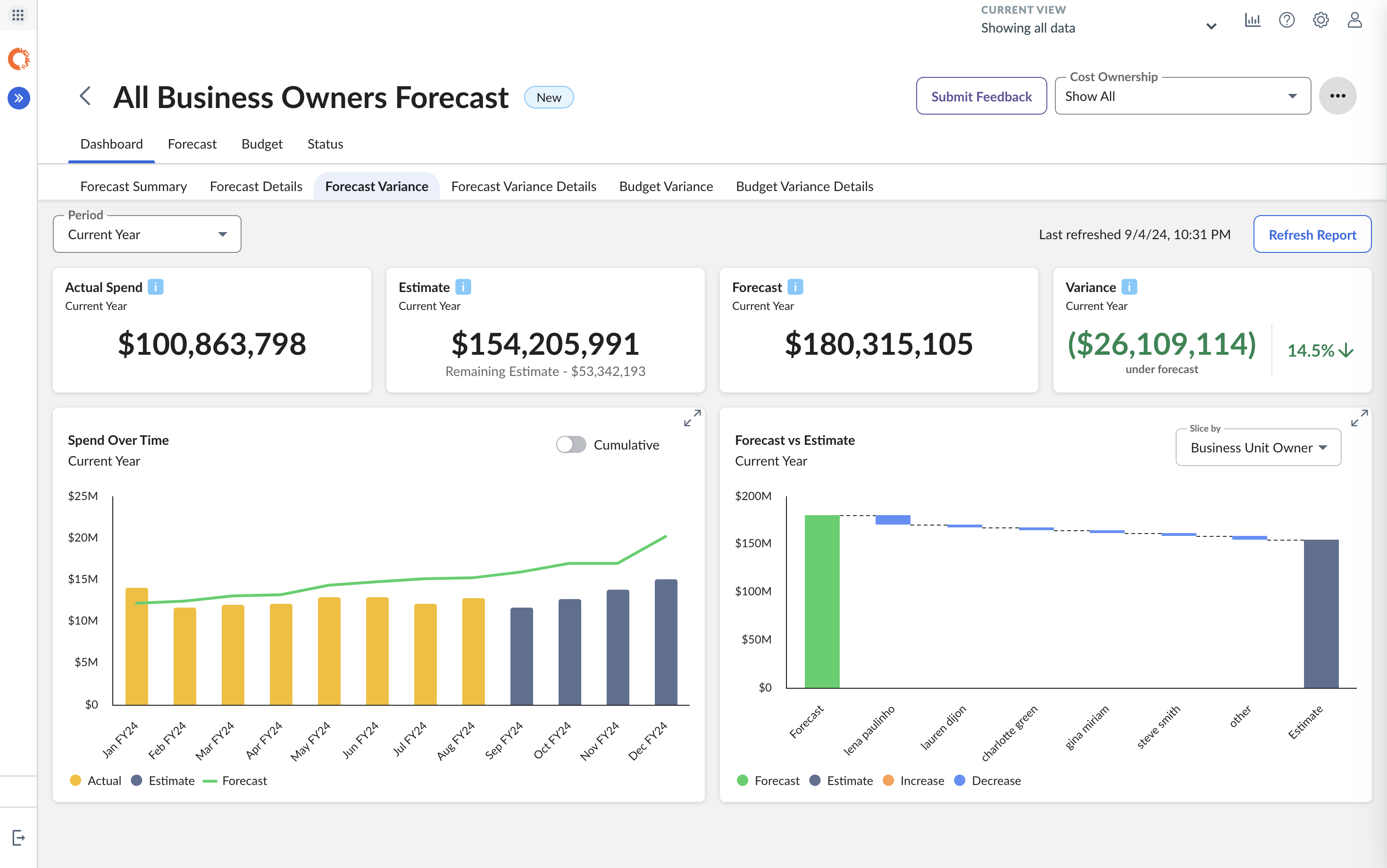
Cloudability is an enterprise cloud financial management platform designed to help organizations understand, allocate, and optimize cloud spend across AWS, Azure, and Google Cloud. It is part of the IBM Apptio portfolio and is often used by FinOps, finance, and IT teams in large organizations.
The platform focuses on cost visibility, allocation, budgeting, forecasting, and rightsizing recommendations. Cloudability normalizes cloud billing data and turns it into standardized reports and dashboards that help teams track spend, support chargeback and showback, and plan future cloud investments.
Pros
- Multi-cloud cost visibility in a single platform
- Cost allocation and chargeback using tags and business dimensions
- Budgeting and forecasting features
- Near real-time cost data for anomaly detection
- Rightsizing and commitment recommendations for savings
- Scales well for large, complex environments
Cons
- Platform can feel complex and heavy, especially for new users
- UI and navigation can be slow with large datasets
- Reporting and dashboards lack flexibility compared to modern BI tools
- Rightsizing recommendations are limited in depth and scope
- Kubernetes and container optimization is weaker than specialized tools
- Data accuracy and reliability issues are occasionally reported
- Pricing is high and not well suited for smaller teams
Best For
Cloudability is best suited for large enterprises that need strong governance, standardized FinOps reporting, and chargeback/showback across multi-cloud environments. It works for organizations with dedicated FinOps teams and structured financial processes.
3. Flexera
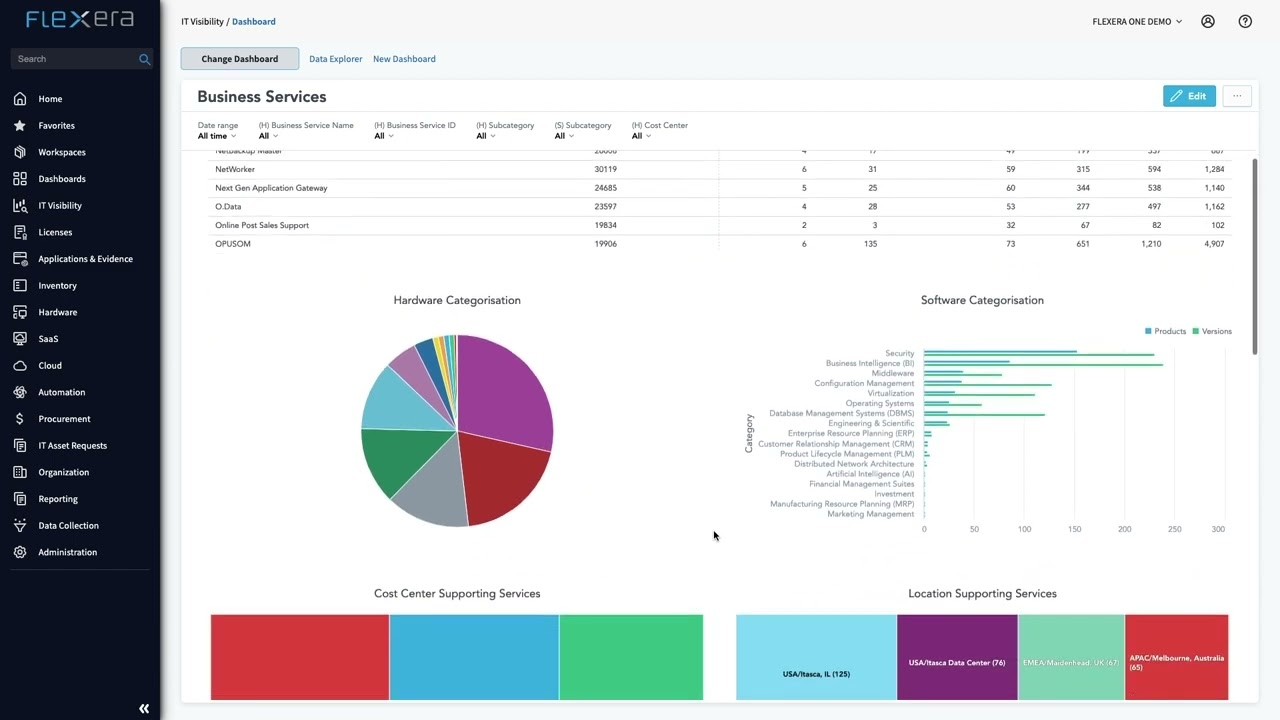
Flexera is an enterprise IT asset and cloud financial management platform designed to provide organizations with broad visibility and governance across cloud, SaaS, and on-premises environments. Its FinOps capabilities are part of a larger portfolio that also covers software asset management (SAM), license compliance, SaaS management, and IT asset discovery.
Flexera helps large organizations track cloud spend, allocate costs, forecast budgets, and enforce governance policies.
Pros
- Broad coverage across cloud, SaaS, and on-prem assets
- Cost allocation, chargeback, and reporting capabilities
- Software license and compliance management
- Multi-cloud visibility across AWS, Azure, and GCP
- Integration with ITSM, CMDB, and procurement tools
- Helps reduce audit risk and improve financial governance
Cons
- Platform can feel heavy and complex, especially at the start
- Steep learning curve and time-intensive setup
- UI and navigation can feel dated or less intuitive
- Some reports and dashboards are slow with large datasets
- Cost optimization is more governance-driven than execution-driven
- Less focused on real-time actions, automation, or daily optimization
- Pricing and services can be expensive for smaller teams
Best For
Flexera is best suited for large enterprises, public sector organizations, and highly regulated environments that need strong governance, compliance, asset management, and standardized reporting across hybrid IT estates.
4. CloudCheckr
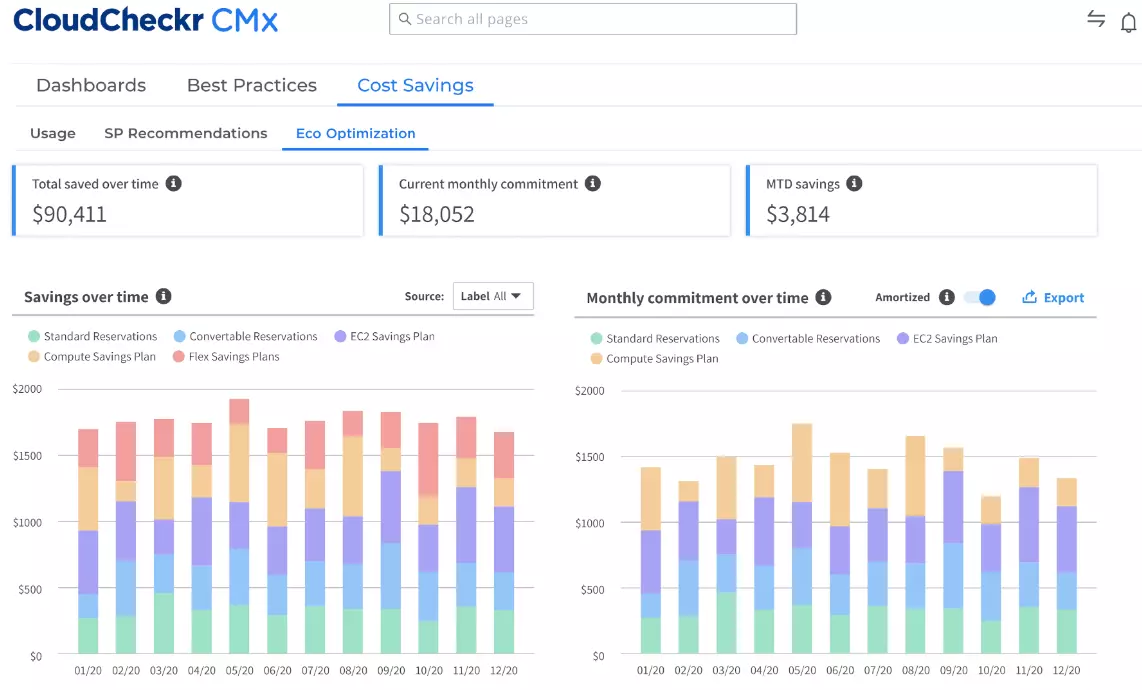
CloudCheckr is an enterprise-focused cloud governance and optimization platform designed to help organizations manage cloud costs, security, compliance, and resource efficiency across AWS, Azure, and Google Cloud. It is now part of the Flexera / Spot FinOps portfolio and is widely used by large enterprises, public sector organizations, and managed service providers.
CloudCheckr combines cost optimization with policy-driven governance. It identifies idle resources, supports rightsizing, manages commitments, and enables automated remediation for security and compliance issues. The platform includes a large set of built-in best-practice rules, detailed reporting, and cross-account visibility, making it suitable for complex and regulated environments.
Pros
- Multi-cloud visibility across AWS, Azure, and GCP
- Broad cost optimization features, including idle resource detection and rightsizing
- Automated remediation for security and compliance issues
- Supports many compliance frameworks and audit requirements
- Combines cost, security, and governance in one platform
Cons
- Steep learning curve due to the number of features and options
- Navigation and UI are often described as hard to use or slow
- Setup and configuration require time and process
- Automated rightsizing and commitment calculations are not always precise
- Can feel like overkill for small or fast-moving engineering teams
Best For
CloudCheckr is best suited for large enterprises, public sector teams, and MSPs that need strong governance, compliance, and standardized cost controls across multi-cloud environments.
5. Finout
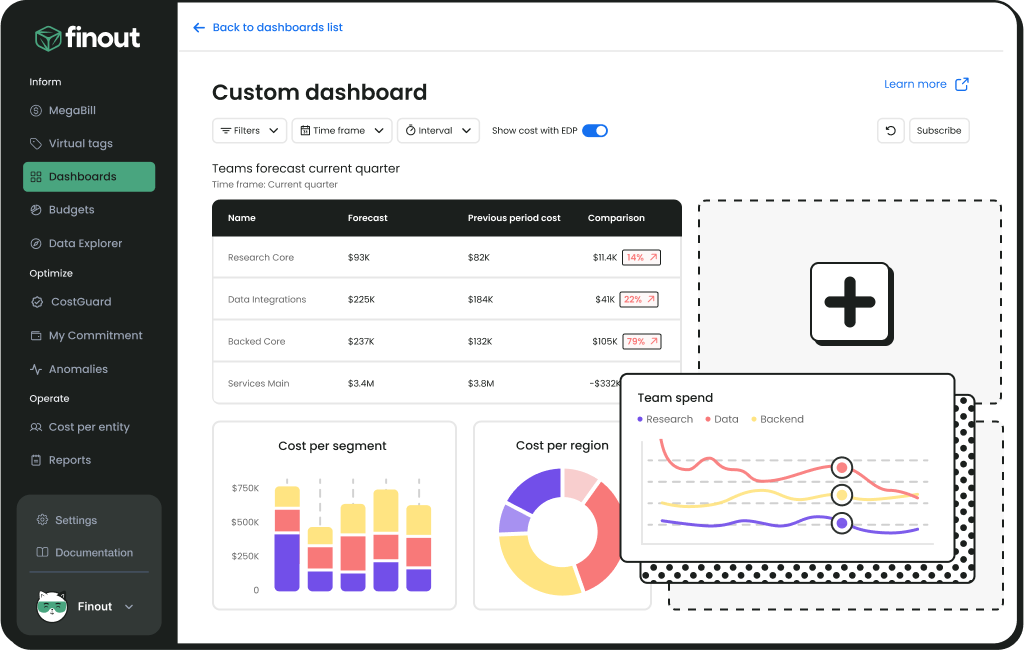
Finout is a cloud cost management and FinOps platform that helps organizations gain clear visibility into their cloud spending and allocate costs accurately across teams, products, and customers. It aggregates cost and usage data from multiple cloud providers such as AWS, Azure, and Google Cloud, along with Kubernetes and selected SaaS tools, into a single unified cost ledger.
The platform emphasizes cost allocation and business context. It enables companies to map cloud spend to real business units like services, features, customers, or environments rather than relying only on accounts or basic tags. Through customizable dashboards, anomaly detection, and unit economics metrics such as cost per customer or cost per request, Finout helps engineering, finance, and product teams understand where cloud costs originate and how they change over time.
Pros
- Multi-cloud cost visibility across AWS, Azure, and GCP
- Strong cost allocation using Virtual Tags and business context
- Unit economics metrics to track cost per customer or service
- Anomaly detection and cost alerts
- Unified view of cloud and some SaaS tool costs
- Helpful for chargeback and showback workflows
Cons
- Steep learning curve for advanced features
- UI can feel complex with many filters and options
- Limited automation and execution of optimization actions
- Commitment management features could be more accurate and automated
- API capabilities are basic, limiting deep integrations
- Performance can slow with very large datasets
Best For
Organizations that need strong cost allocation, business context mapping, and visibility across multiple cloud providers and want to connect cloud costs to unit economics.
6. Anodot

Anodot is an AI-driven analytics and cost management platform that focuses on real-time anomaly detection, forecasting, and alerts. It analyzes metrics and cost data to detect unusual behavior and notify teams before issues grow into larger problems.
In cloud cost management, Anodot provides visibility into cloud spend, usage, and trends across multiple cloud providers, Kubernetes environments, and some SaaS tools.
Pros
- AI-based anomaly detection for costs and metrics
- Real-time alerts that help teams catch issues early
- Multi-cloud visibility
- Forecasting and trend analysis capabilities
- Recommendations for identifying waste and inefficiencies
- Helps reduce manual monitoring effort
Cons
- User interface can feel complex or cluttered, especially for new users
- Steep learning curve for non-technical users
- Limited role-based access control and governance features
- Custom alert configuration can be restrictive
- Pricing can be high for smaller teams
- Execution and automation of cost optimization actions are limited
- Better at detection than at driving cost-saving actions to completion
Best For
Anodot is best suited for organizations that need advanced anomaly detection and real-time monitoring of cloud costs and business metrics. It works well for teams that want to detect cost spikes, usage changes, or unusual patterns quickly and rely on AI-driven insights.
7. DoiT
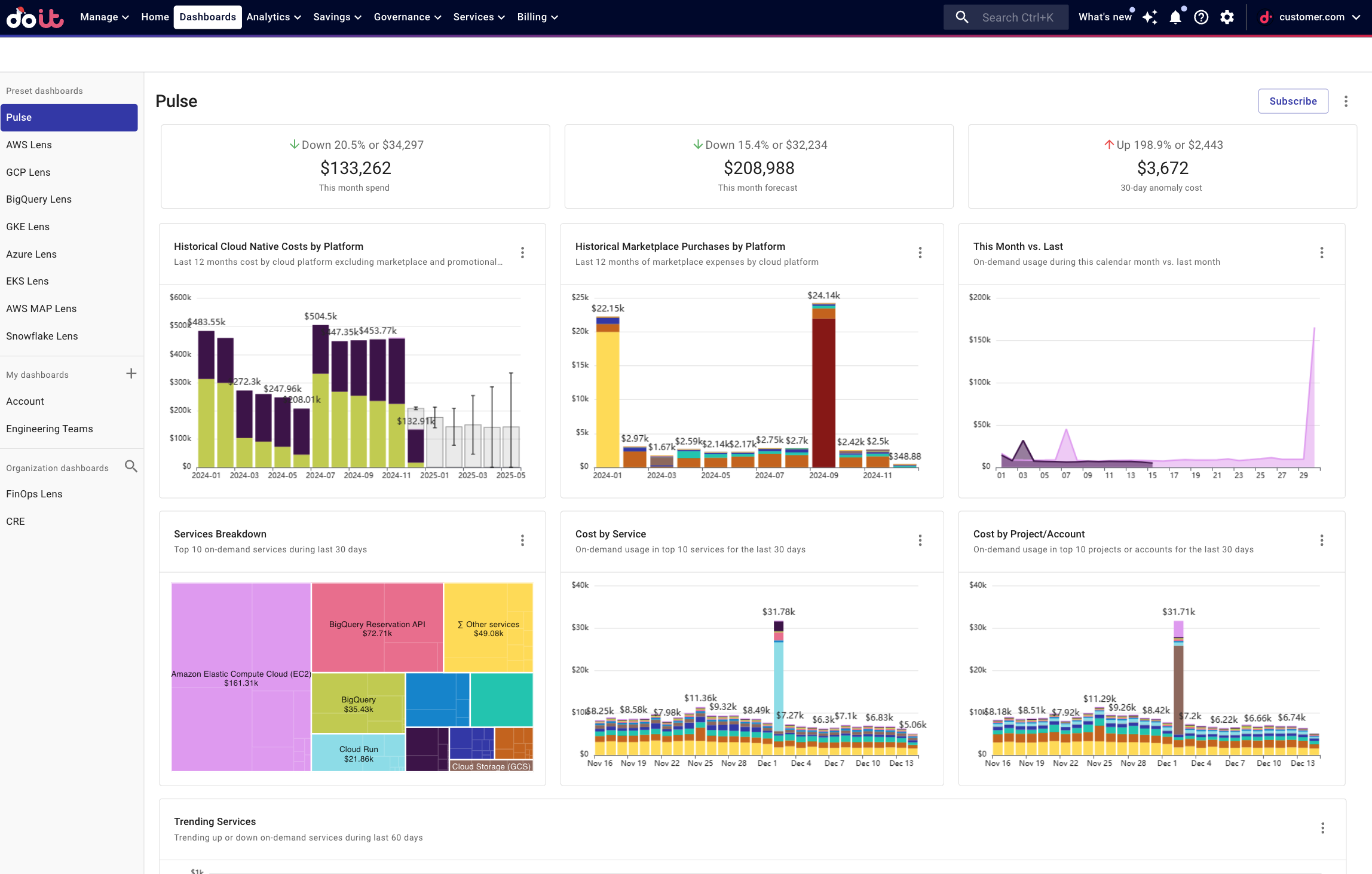
DoiT is a cloud intelligence and FinOps platform that helps organizations manage cloud costs, improve performance, and optimize reliability across AWS and Google Cloud, with growing multi-cloud support. DoiT is often used not only as a tool, but also as a cloud partner, providing access to experienced engineers and architects.
The platform focuses on cost visibility, reporting, anomaly detection, and optimization insights.
Pros
- Cost allocation and anomaly detection
- Easy onboarding and fast integration
- Strong technical support and cloud expertise
- Helpful for rightsizing, performance tuning, and architecture guidance
- Combines tooling with expert, on-demand assistance
Cons
- Platform UI and navigation can feel confusing
- Reporting filters and dashboards take time to get used to
- Cost and anomaly data may not always be near real time
- Forecasting accuracy is limited
- Automation is more advisory than execution-driven
- Some features depend heavily on human involvement
- Billing and contract structure can feel complex
Best For
DoiT is best suited for organizations that value expert support alongside tooling, especially teams running on AWS or GCP that need help with cost optimization, architecture decisions, and cloud provider interactions.
8. Cast.ai
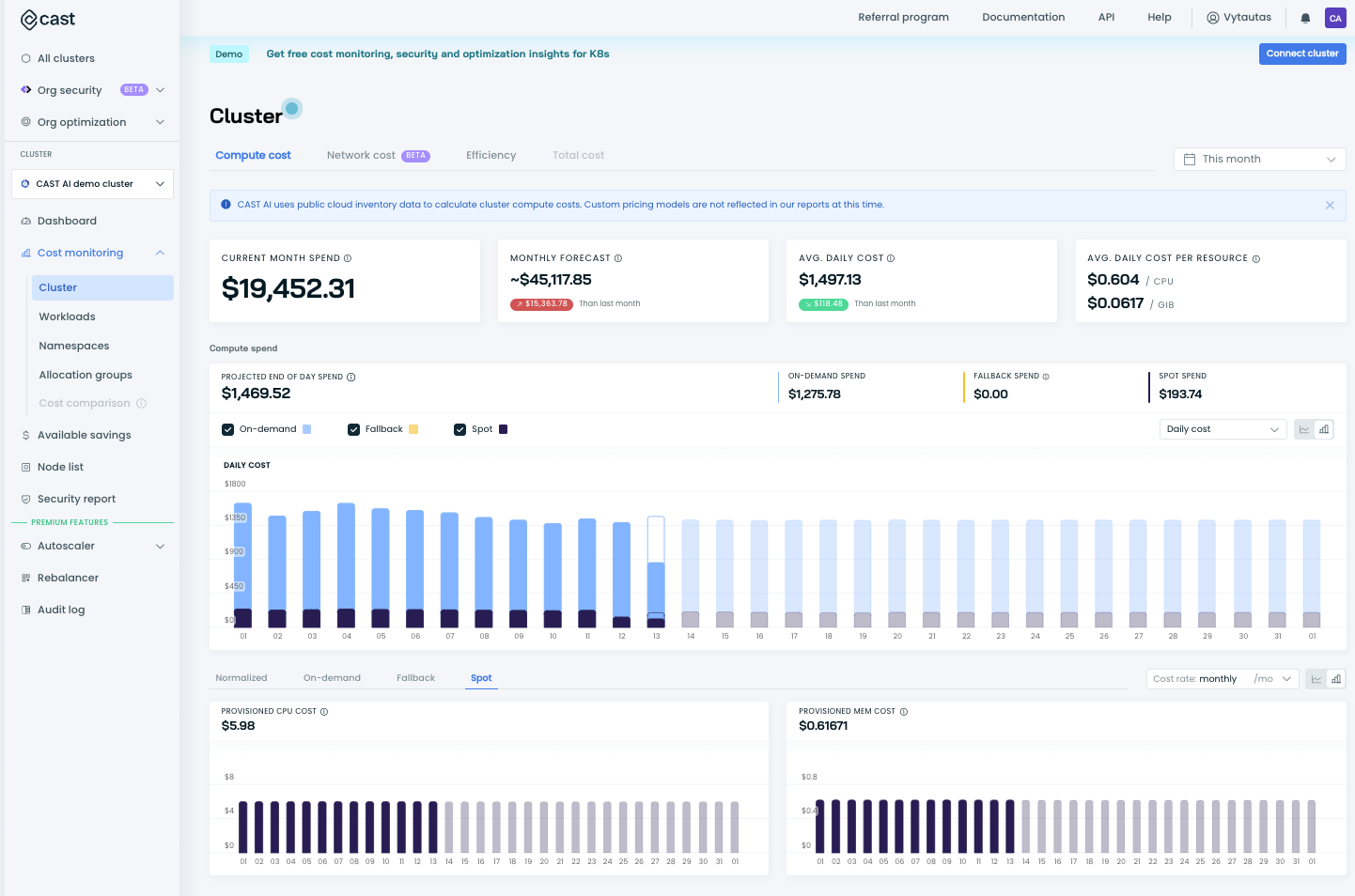
CastAI is a Kubernetes automation and cost optimization platform focused on reducing cloud costs while improving cluster efficiency. It automatically manages node provisioning, autoscaling, rightsizing, and Spot Instance usage across Kubernetes clusters running on AWS, Azure, and Google Cloud.
Instead of only showing recommendations, CastAI actively takes control of cluster optimization. It analyzes workloads in real time and replaces nodes, rebalances clusters, and selects the most cost-effective instance types without manual intervention.
Pros
- Automation for Kubernetes cost optimization
- Automatic node selection, scaling, and rebalancing in real time
- Supports AWS EKS, Azure AKS, and Google GKE
- Works with Infrastructure as Code tools like Terraform and Helm
- Visibility into Kubernetes costs at cluster, namespace, and workload level
- Built-in security scanning and policy controls
Cons
- Focused almost entirely on Kubernetes, not full cloud cost management
- Initial setup and governance features can have a learning curve
- Policy configuration and permissions are limited for large, shared environments
- UI and reporting can feel basic for financial or executive users
- Pricing may feel high for small clusters or teams
- Less suitable for organizations that want manual control instead of automation
Best For
CastAI is suited for Kubernetes-heavy organizations that want hands-off, automated cost optimization without managing cluster scaling and node selection manually.
9. Datadog
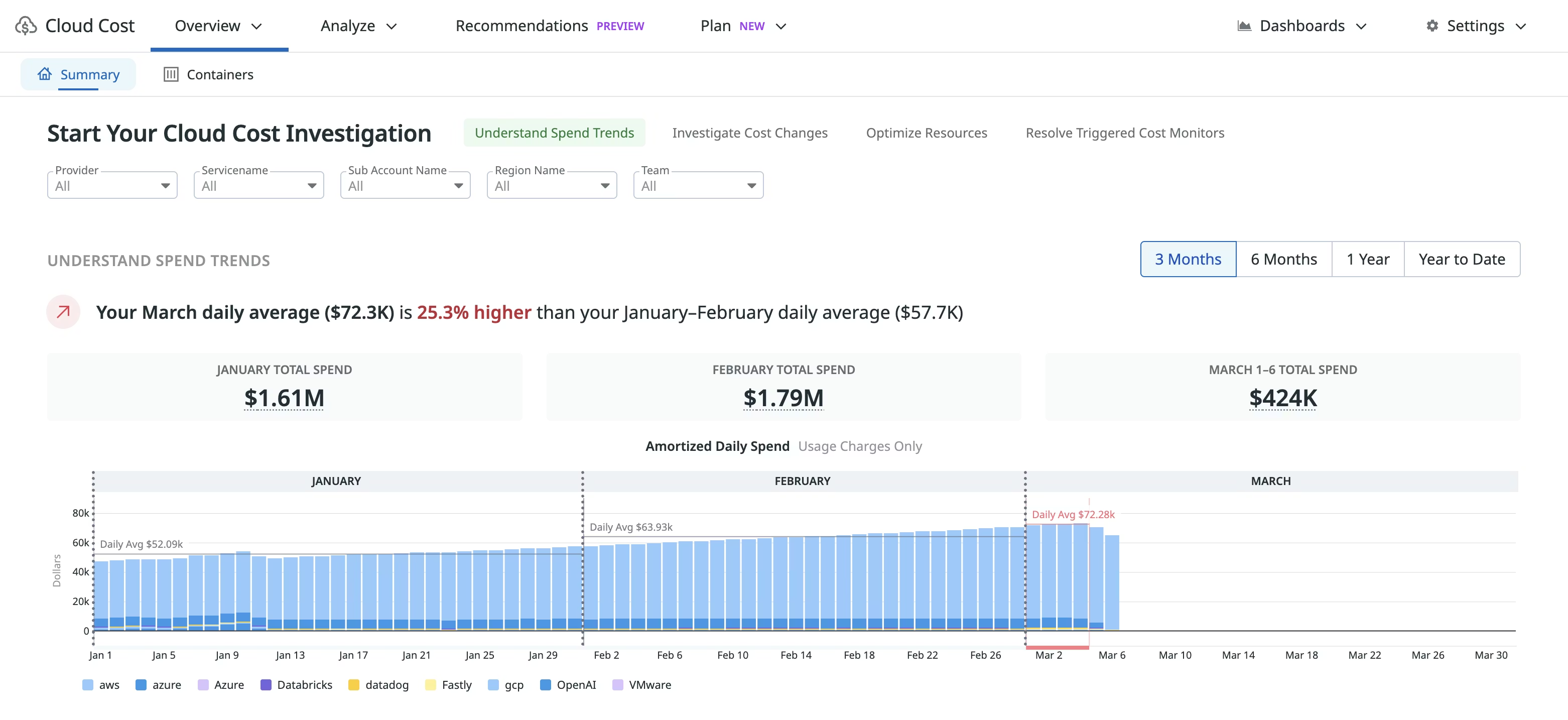
Datadog is a comprehensive observability and monitoring platform that unifies metrics, logs, traces, and application performance monitoring (APM) in a single interface. It provides real-time visibility across infrastructure, applications, and microservices architectures. The platform integrates seamlessly with major cloud providers and supports container-based, server-based, and web-based applications.
Datadog also includes a Cloud Cost Management module, which allows teams to view cost data alongside performance metrics.
Pros
- Combines observability and cost data in one platform
- Easy to link cost changes with performance issues
- Strong Kubernetes and container-level cost visibility
- Built-in anomaly detection and cost alerts
- Works well for engineering-led teams already using Datadog
Cons
- Cost management features are secondary to monitoring
- Limited FinOps workflows, budgeting, and forecasting
- Optimization and execution capabilities are basic
- Pricing grows quickly as data ingestion increases
- Overkill for teams that need only cloud cost management
Best For
Organizations already using Datadog for observability and wanting basic cost visibility inside engineering workflows.
10. nOps
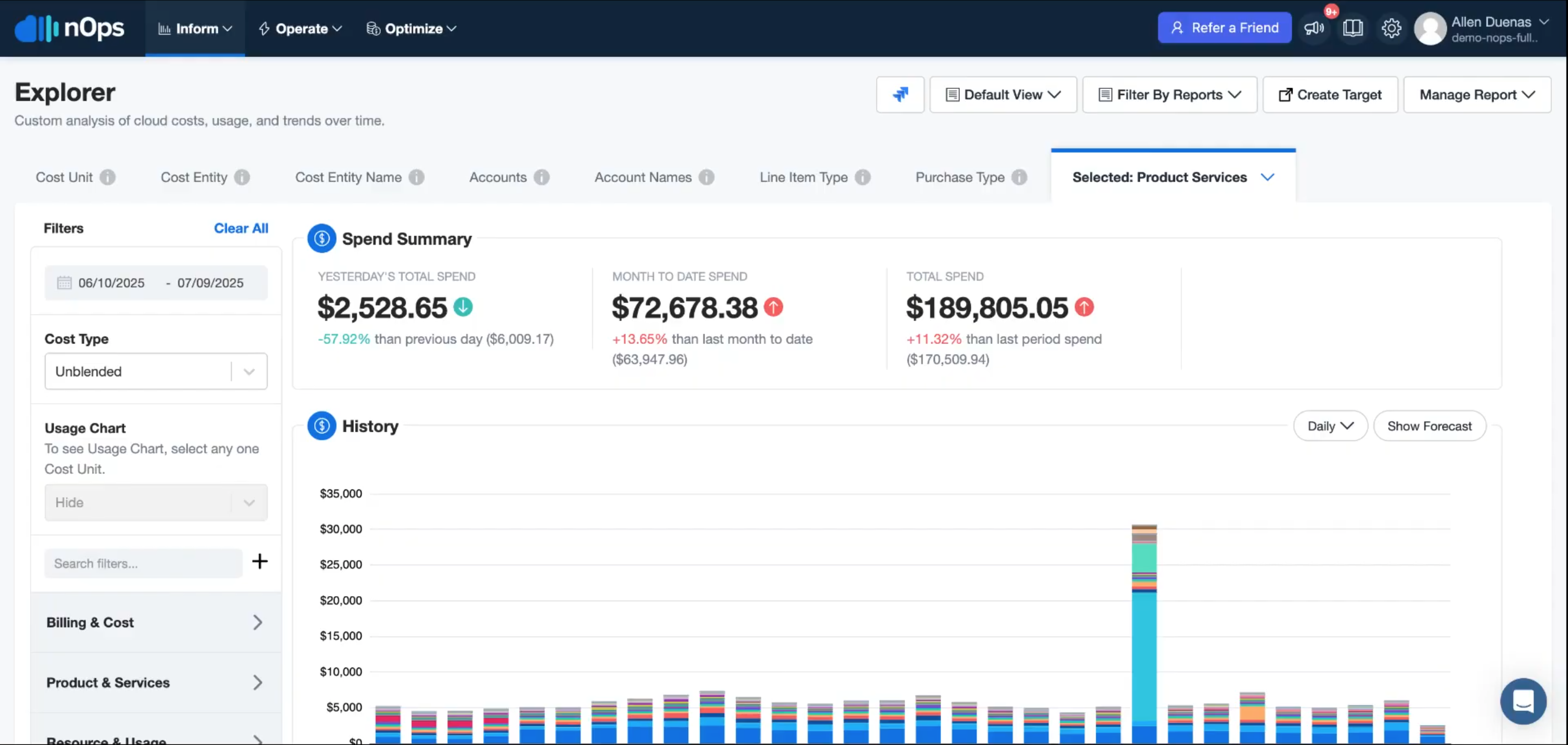
nOps is an AWS-focused cloud cost optimization platform designed to automate savings and reduce manual FinOps work. It continuously analyzes AWS usage and applies cost-saving strategies using Reserved Instances, Savings Plans, and Spot Instances. The platform is built to help teams reduce on-demand usage and improve commitment utilization with minimal ongoing effort.
A key part of nOps is automation. It manages Savings Plans and RI lifecycles, selects cost-effective compute options, and identifies idle or underutilized resources. nOps also includes basic security and compliance monitoring, making it a combined cost and operations tool for AWS environments.
Pros
- Automation for Savings Plans and Reserved Instances
- Effective use of Spot Instances to reduce compute costs
- Reduces manual work around commitment management
- Visibility into AWS cost savings and utilization
- Useful for EC2, EKS, and some RDS optimization
Cons
- Limited to AWS-only environments
- Some automation can feel heavy or hard to control
- Reporting and forecasting features are basic
- Customization options are limited compared to larger FinOps platforms
- UI and features can feel inconsistent or less polished
- Advanced features come at a higher cost
Best For
nOps is best suited for AWS-centric organizations that want automated, hands-off cost optimization, especially for EC2 and compute-heavy workloads.
Conclusion
The alternatives covered in this guide address different needs, from traditional enterprise platforms to modern specialized tools for cost optimization, Kubernetes, or anomaly detection. Choosing the right solution depends on your cloud complexity, FinOps maturity, and how proactively you want to manage costs.
While CloudHealth provides solid multi-cloud visibility and governance, organizations often need more than just reporting and policy enforcement. Moving from traditional cloud management to modern FinOps requires platforms that combine visibility with execution, automation, and collaboration.
For teams looking to move beyond legacy reporting tools toward continuous cost control, platforms like Cloudchipr offer a more complete approach, combining visibility, allocation, forecasting, alerts, automated actions, and team collaboration in a single unified workflow.